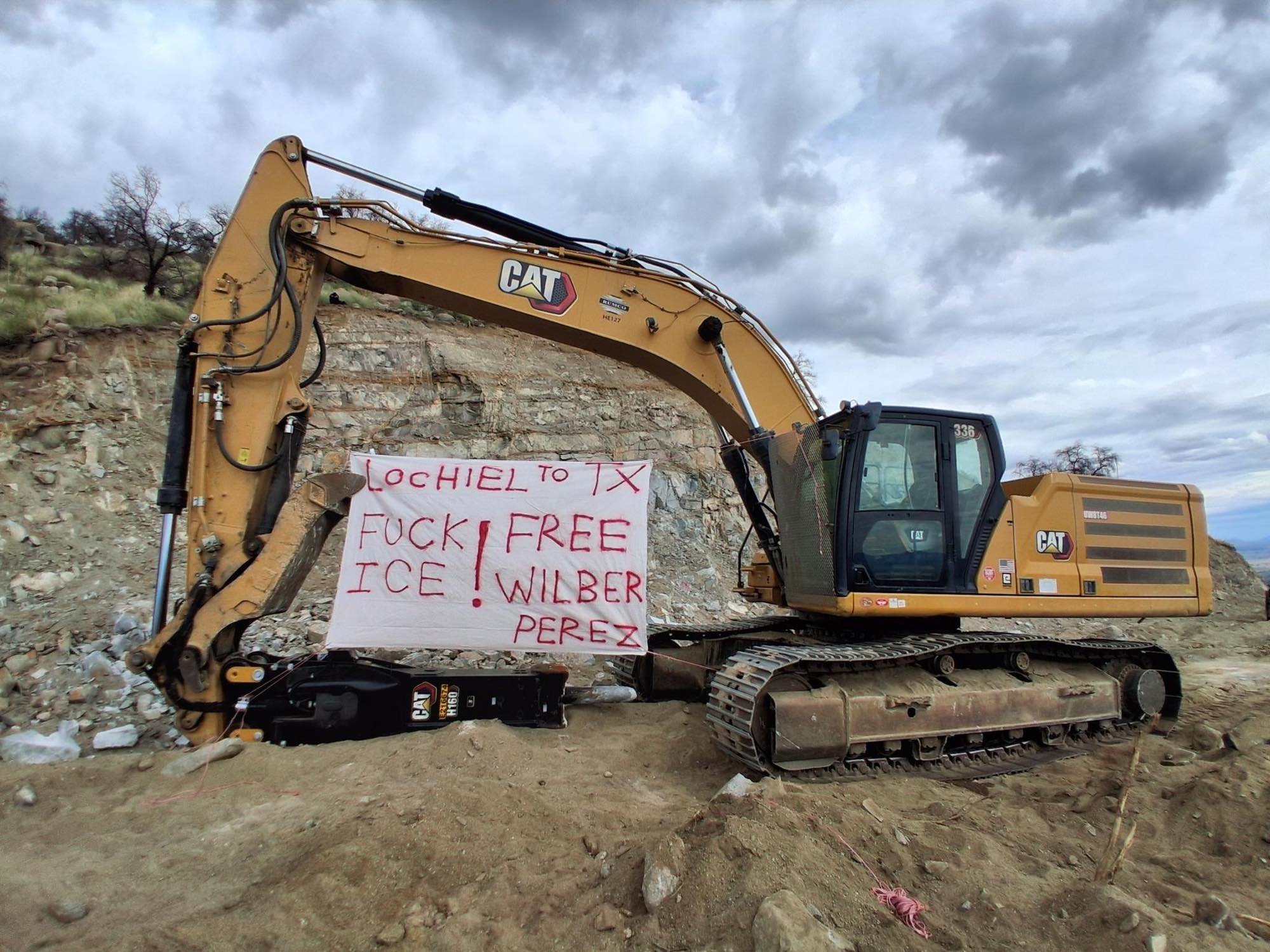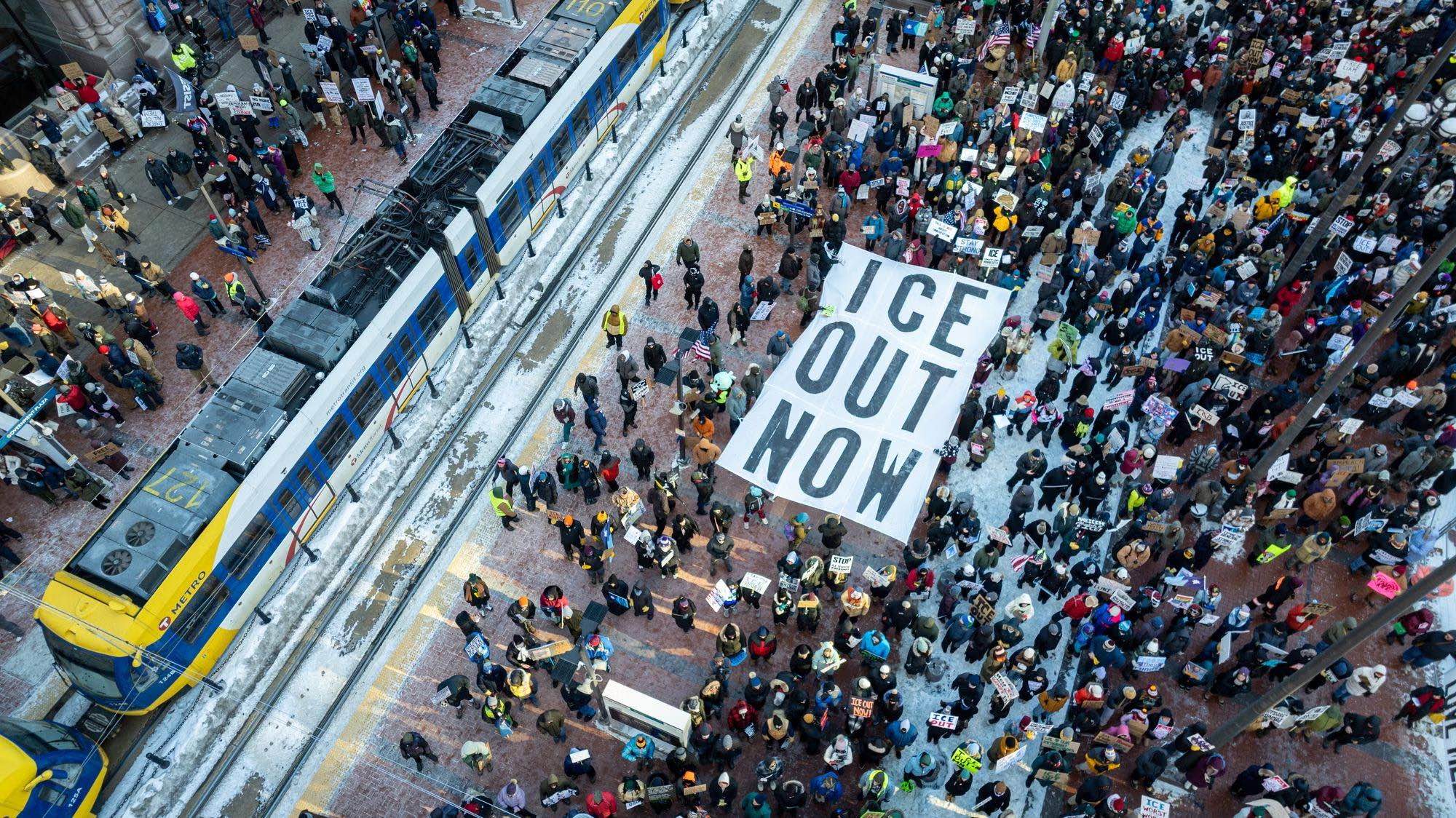


What do we want for May Day? In short, to take another step towards freedom from all forms of oppression—towards what we call anarchy, by which we mean egalitarian relationships based in self-determination, solidarity, and mutual aid. Anarchists have been central to May Day since its origins as a labor holiday in 1886, when police in Chicago attempted to suppress anarchist labor organizers who were fighting for right to the eight-hour workday. Today, as intensifying authoritarianism propels more and more people into action, we have a window of opportunity to make real change. Towards that end, we present some starting points and a handbill to promote them.
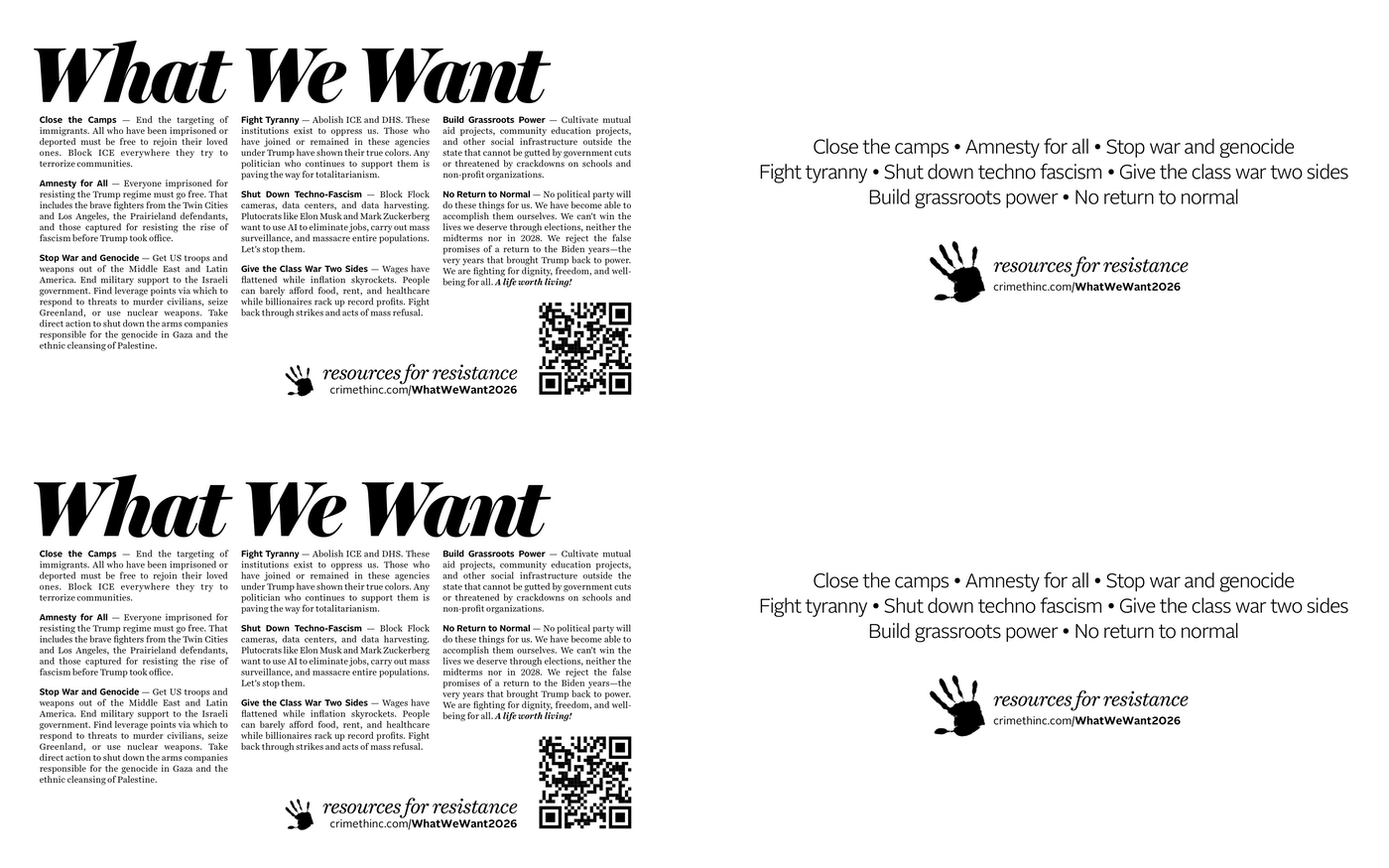
Click the image to download and print the PDF.
A Strike Is a Blow
This year, inspired in part by the massive general strike in the Twin Cities on January 23 in response to the Immigration and Customs Enforcement terror campaign, many people around the country are calling for a general strike on May Day. Fully one in four adults in Minnesota participated in the January 23 general strike in some way. We probably won’t see anything approaching that scale in most of the country on May Day, but nonetheless, it is a step towards building the collective capacity to use economic leverage against capitalists and despots.
Various liberal organizations are calling for strikes and boycotts. To carry off a real general strike, however, will take more than a voluntary pause in working and consuming. Much has changed in the economy since the powerful strikes of the early 20th century that won the rights workers are now losing. The shift of the majority of workers from industrial production jobs into the service industry and the introduction of automation have made it much more difficult to paralyze the economy simply by walking out of our workplaces.
A few years ago, we published a detailed analysis of the last two general strikes that occurred in Oakland, California (in 1946 and 2011), exploring how labor and labor struggles have changed over the past century and how this ought to inform our efforts to update the strike and other forms of resistance for the 21st century.
We summarized our findings thus:
What would a modern-day general strike look like? It would involve a broad range of precarious workers, unemployed people, and other rebels taking disruptive action to shut down the economy from outside. However the strike might begin, it would have to proliferate horizontally, spreading beyond any single demographic as a contagious rebellion exceeding the control of any organization. It would entail targeting the choke points of the economy—physical locations like ports, highways, and distribution centers as well as online venues and other forms of infrastructure, not to mention the workplaces, schools, neighborhoods, and prisons in which most of us spend most of our lives. It would necessitate defying politicians, union representatives, community leaders, and everyone who defends their legitimacy. It would be controversial. To persist, it would require seizing and redistributing resources. Many of these actions would take place within workplaces, but to center the agency of official unions or other organizations that have legal standing under capitalism would be to ensure defeat in advance.
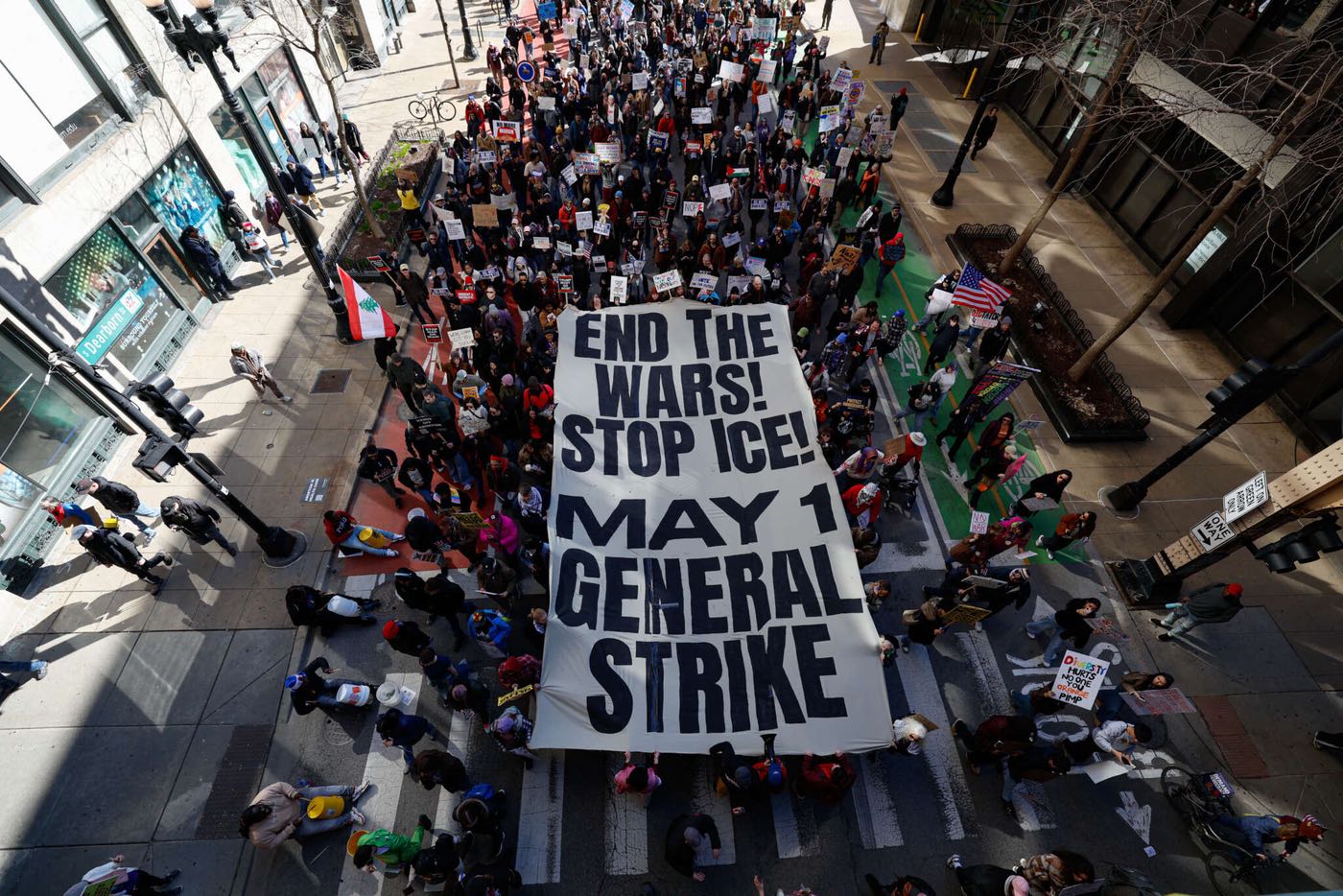
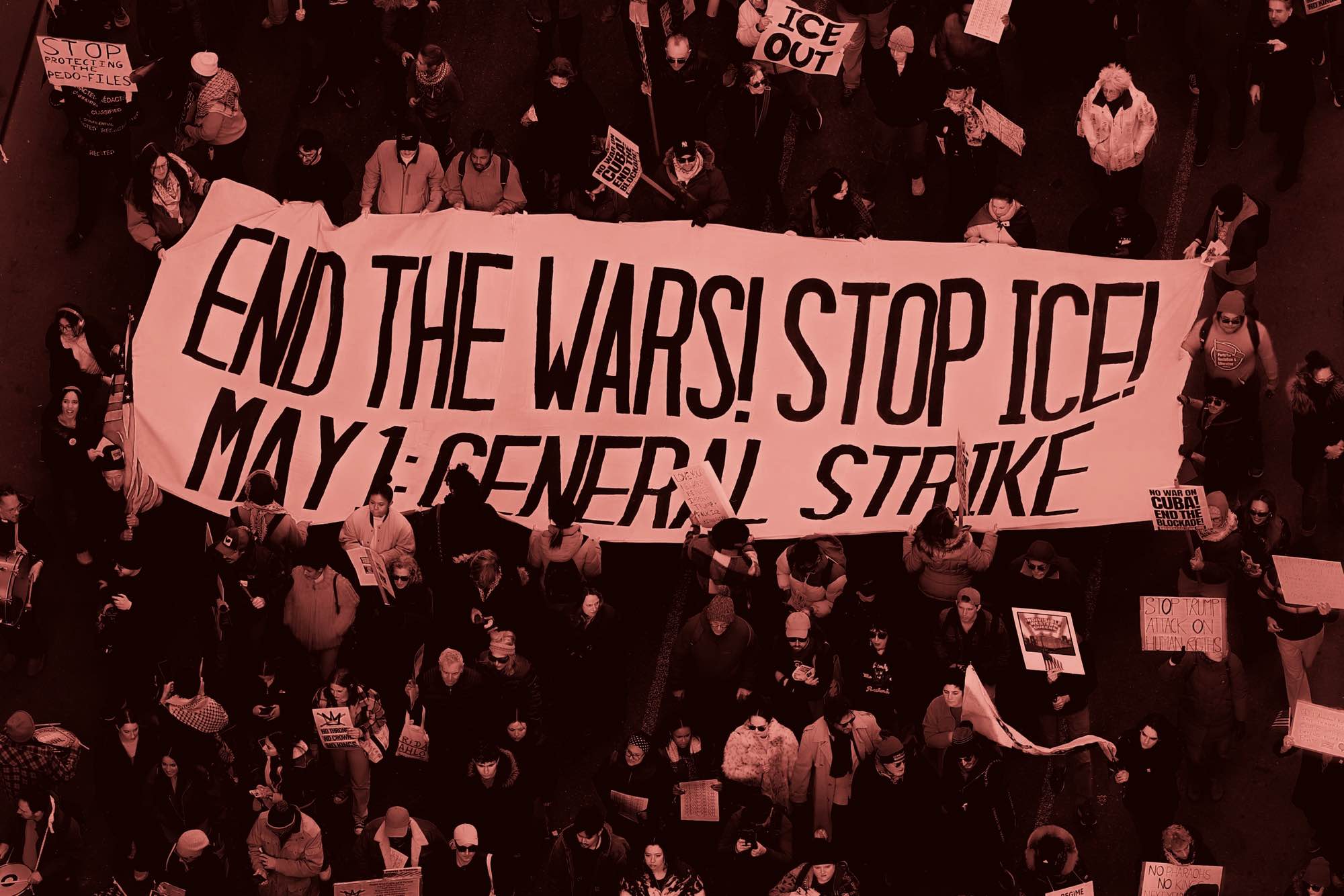
Demonstrators in Chicago display a banner during the “No Kings” protest on March 28, 2026.
Aim Beyond the Target
Temporarily shutting down the economy is only one step on the road towards a better world. We also have to identify the changes that we want to make and move towards them proactively.
At a time when “Abolish ICE” has become a viable political proposal, there is now a risk that people will be drawn into passive electoral programs, mistaking them for radical social change. Why is this dangerous?
The uprising of 2020—the most powerful social movement in living memory—began when people took direct action to impose consequences on the Minneapolis police for murdering George Floyd. In response to the burning of the Third Precinct, millions of people around the country leaped into action. The movement only reached a plateau when reformists regained control, proposing to defund the police through municipal initiatives rather than grassroots action. By the time it became clear that local and state governments were never going to do any such thing, the movement had lost its momentum.
The lesson is clear: we have to become capable of making the changes we desire directly. Governments will only grant us what they know we can accomplish for ourselves.
The best way to distinguish our proposals from those of electoral reformists is to organize actions via which people can immediately achieve concrete effects. These actions should transform the participants’ relationship to their own agency, enabling them to develop a stronger sense of their power and a clearer understanding of the advantages of grassroots horizontal organizing.
Engineering consists of breaking down a big goal into a series of achievable concrete tasks. We would do well to work out what the steps are to doing away with autocracy once and for all, and propose things that people can do right now to take a step towards this. At the same time, we should also spell out the subsequent steps in the process, the ones that we are aiming to build capacity to undertake, so that reformists are not able to usurp momentum for social change.
The movement against ICE in the Twin Cities demonstrates the effectiveness of this approach. Once a large number of people understood that they could make a difference by forming rapid response networks and engaging in other forms of direct action, the power dynamics in the Twin Cities shifted and the Trump regime was forced to dial down its assault. Once again, the movement went no further only because it was not clear to enough people what the next step in the process might be. We need to promote a wide array of reproducible grassroots tactics that can be taken up far outside radical circles—ideally, tactics that aren’t especially difficult or costly to try out in relation to what one can achieve by using them—and popularize a clear roadmap to social change that does not rely on parties or politicians.
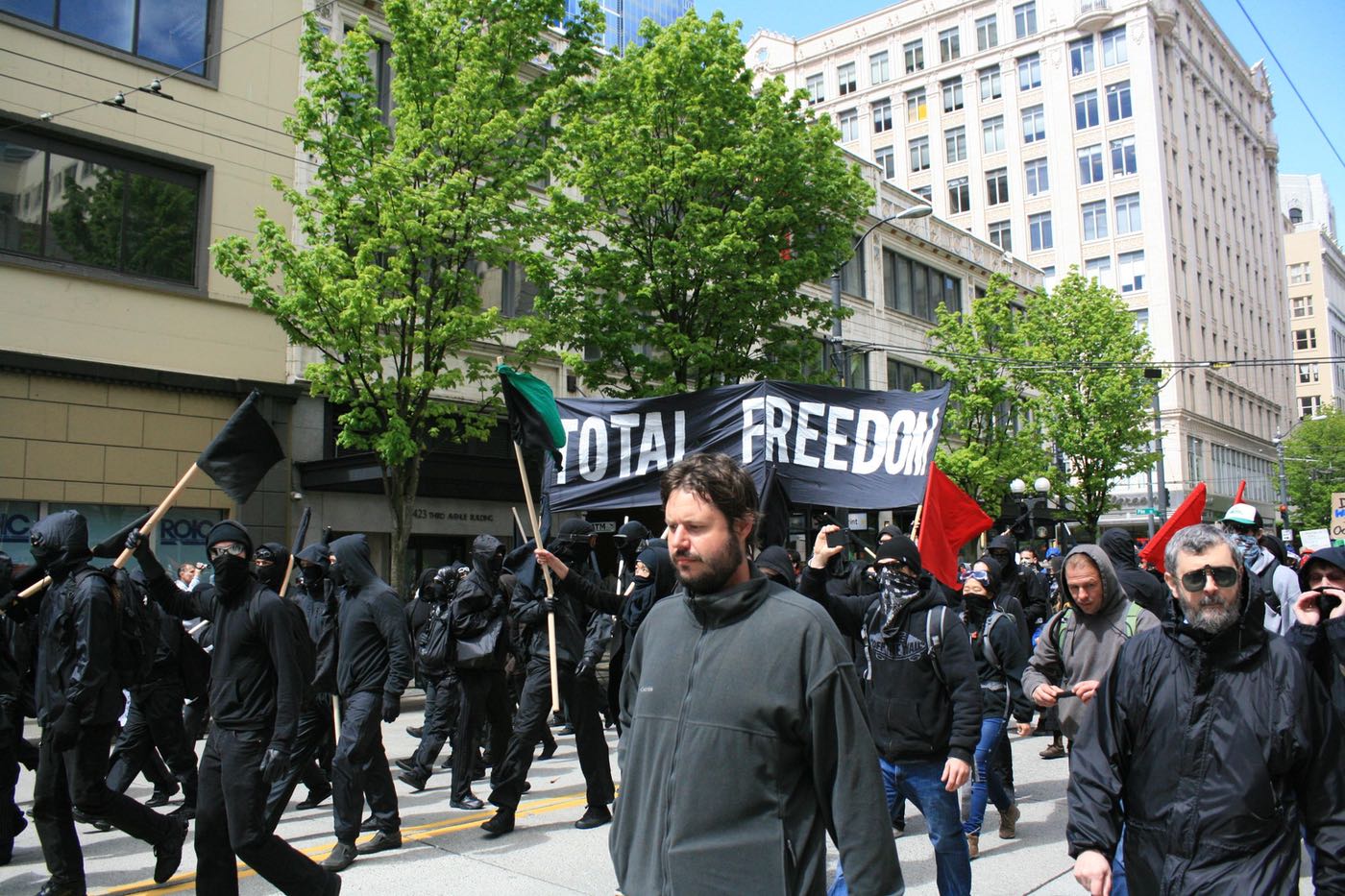
Anarchists march through downtown Seattle on May Day 2012, en route to smash up the same Niketown outlet famously damaged by demonstrators against the 1999 World Trade Organization summit.
What We Want for May Day
A few starting points.
Close the Camps
End the targeting of immigrants. All who have been imprisoned or deported must be free to rejoin their loved ones. Block ICE everywhere they try to terrorize communities.
Volunteers in Chicago and the Twin Cities have demonstrated how to organize rapid response networks to resist ICE operations. The next step is to discuss what kind of collective action could serve to shut down the detention centers and free those held captive there.
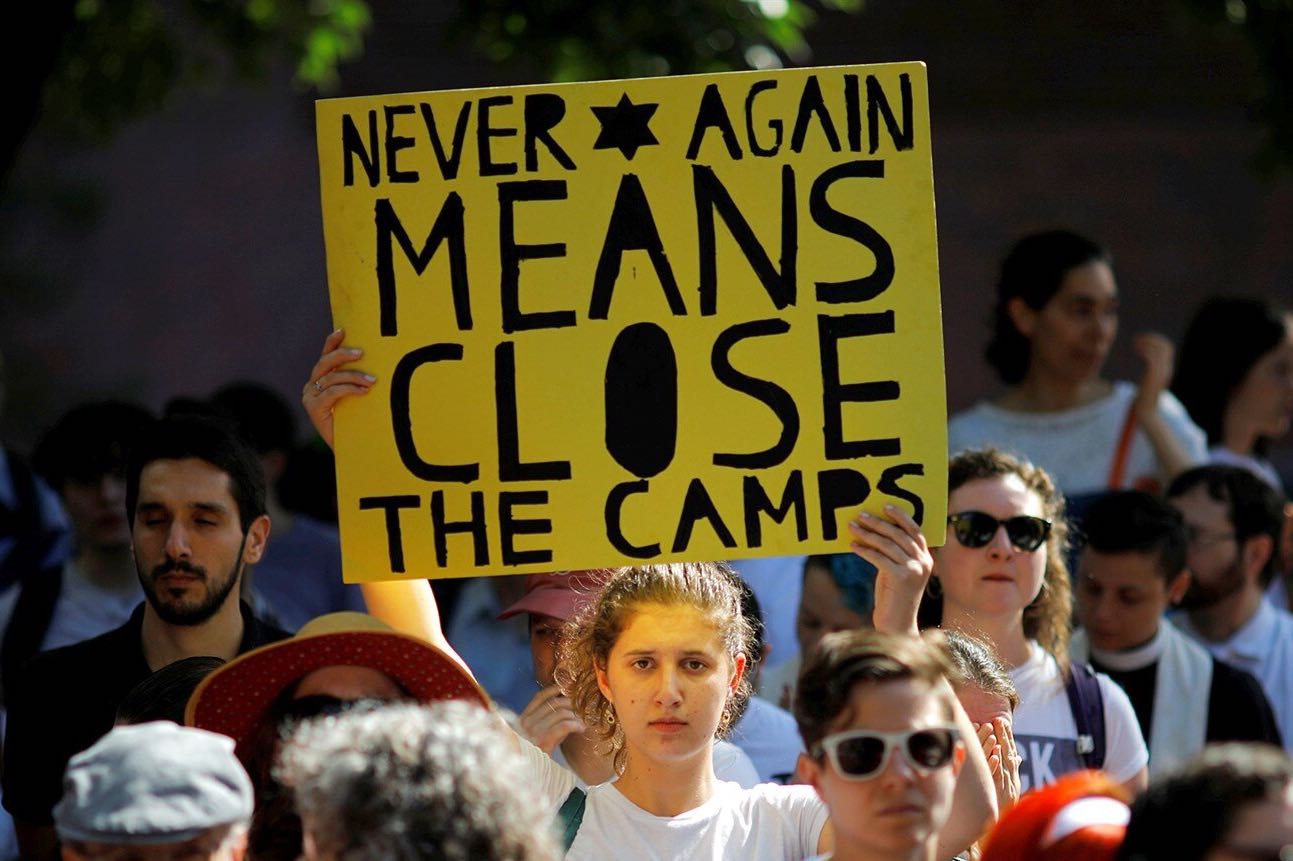
Demonstrators participate in a protest initiated by Jewish groups against ICE detention camps in Boston on July 2, 2019.
Amnesty for All
Everyone imprisoned for resisting the Trump regime must go free. That includes the brave fighters from the Twin Cities and Los Angeles, the Prairieland defendants, and those captured for resisting the rise of fascism before Trump took office.
To support defendants and prisoners today, you can host a fundraiser event or a noise demonstration outside a jail or prison. To bring them home tomorrow, look for means of pressure via which to put politicians and capitalists in a position in which it is better for them to call for amnesty for all.
Stop War and Genocide
Get US troops and weapons out of the Middle East and Latin America. End military support to the Israeli government. Find leverage points to respond to threats to murder civilians, seize Greenland, or use nuclear weapons. Take direct action to shut down the arms companies responsible for the genocide in Gaza and the ethnic cleansing of Palestine.
How can ordinary people exert leverage on the foreign policy of an authoritarian government? The blockades and university occupations with which demonstrators have pressured Boeing, Raytheon, and other pillars of the military-industrial complex offer one starting point.
Fight Tyranny
Abolish ICE and DHS. These institutions exist to oppress us. Those who have joined or remained in these agencies under Trump have shown their true colors. Any politician who continues to support them is paving the way for totalitarianism.
Disrupt ICE and Department of Homeland Security recruiting events. Stigmatize serving federal agencies as a mercenary inflicting violence on communities. Organize demonstrations exerting pressure on vulnerable Democrat politicians not to fund DHS under any conditions, regardless of whether Republicans agree to reforms.
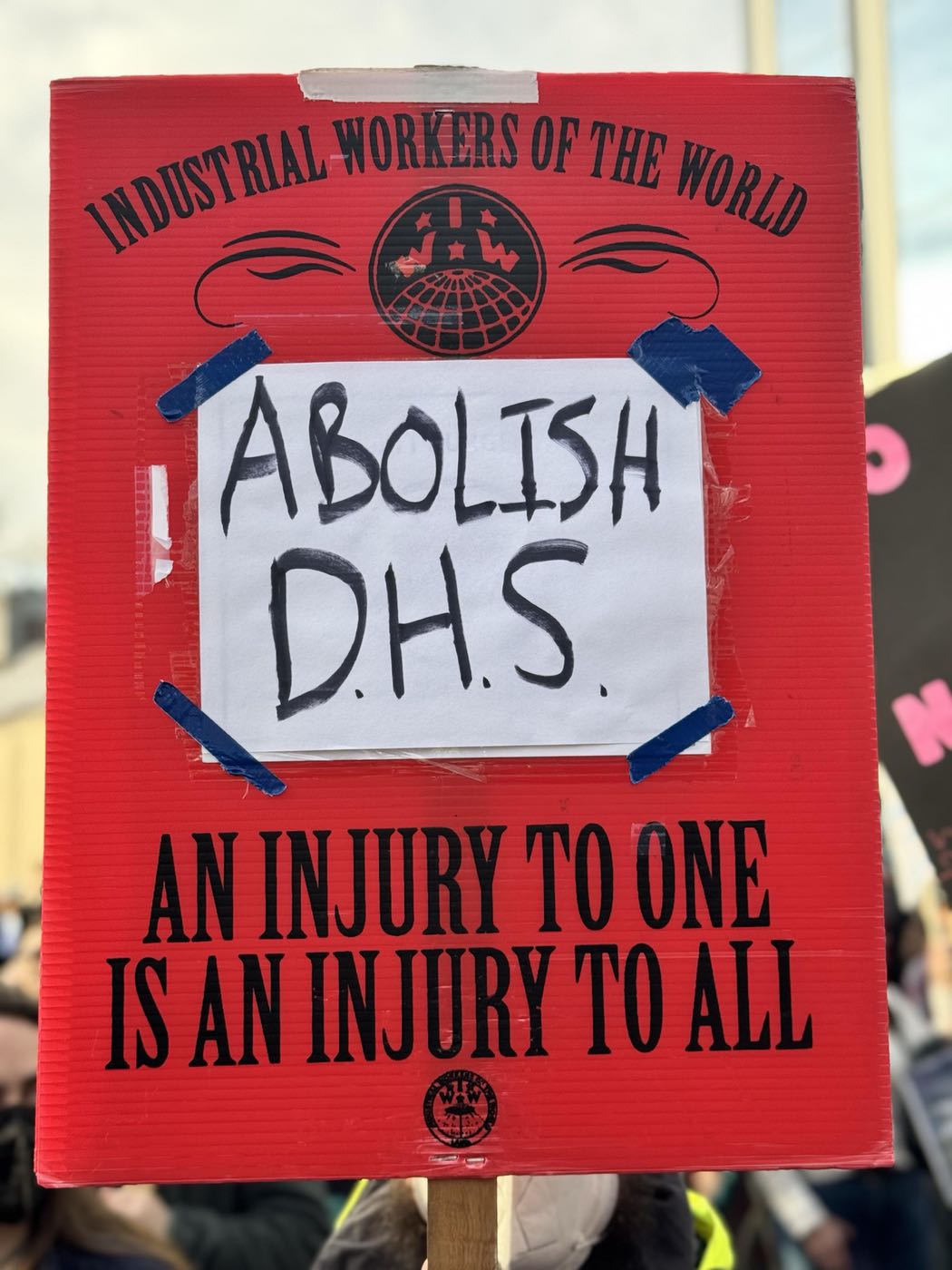
A sign displayed during protests against the Portland ICE facility at the end of January 2026. Photograph by Alissa Azar.
Shut Down Techno-Fascism
Oligarchs like Elon Musk and Mark Zuckerberg want to use AI to eliminate jobs, carry out mass surveillance, and massacre entire populations. Block Flock cameras, data centers, and data harvesting.
People around the country are mapping and disabling Flock surveillance cameras and mobilizing to oppose the construction of data centers. Above all, we should spread the understanding that tech moguls are fundamentally aligned with an autocratic political agenda.
Give the Class War Two Sides
Wages have flattened while inflation skyrockets. People can barely afford food, rent, and healthcare while billionaires rack up record profits. Fight back through strikes and acts of mass refusal.
The political crisis in the United States today is the consequence of economic processes that have been underway for generations. The rise of fascism is not a fluke brought about by the demagoguery of a single individual, but the logical outcome of profit-driven capitalism. We must develop the capacity to strike, blockade, and shut down the economy as a step towards completely reinventing our economic relationships and redistributing resources on an egalitarian basis.
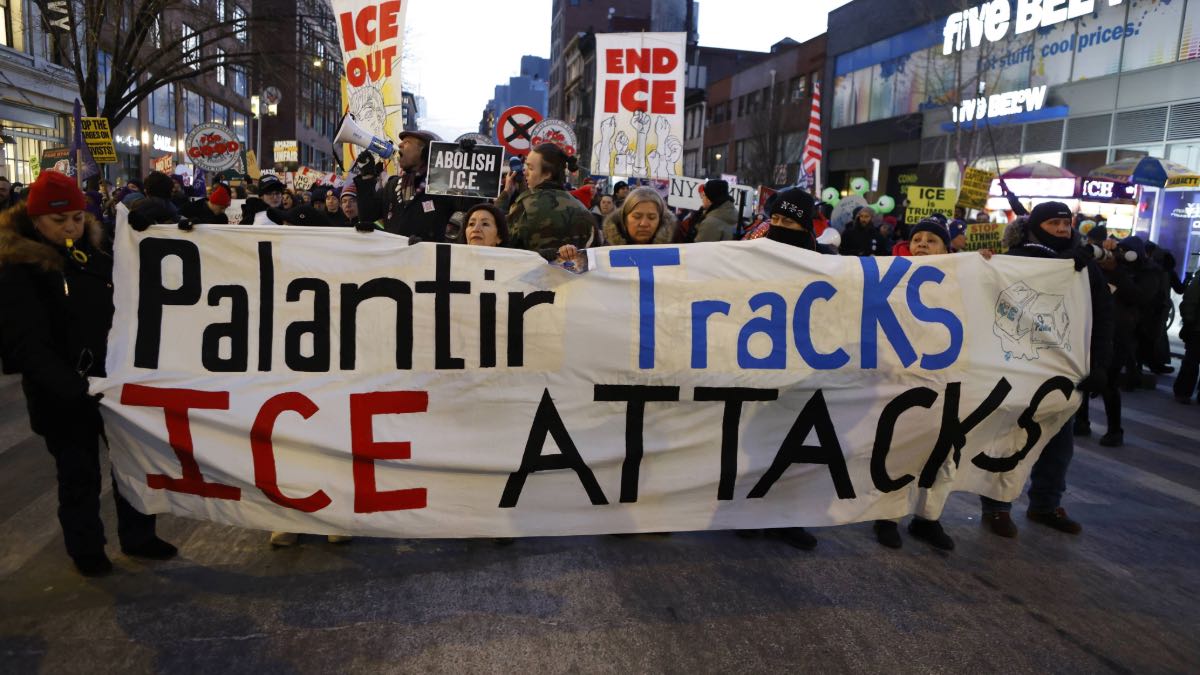
Demonstrators in New York City march in solidarity with those in the Twin Cities resisting ICE on January 23, 2026.
Build Grassroots Power
Cultivate mutual aid projects, community education projects, and other social infrastructure outside the state that cannot be gutted by government cuts or threatened by crackdowns on schools and non-profit organizations.
Every community can organize regular Really Really Free Markets and other forms of mutual aid infrastructure through which people can interchange resources and meet their needs collectively. These should be a step towards creating communities that are able to take action together on a massive scale.
No Return to Normal
No political party will do these things for us. We have become able to accomplish them ourselves. We can’t win the lives we deserve through elections, neither the midterms nor in 2028. We reject the false promises of a return to the Biden years—the very years that brought Trump back to power. We are fighting for dignity, freedom, and well-being for all. A life worth living!
Democrats’ attempts to preserve an unbearable status quo were what got us into this mess in the first place. Nothing less than profound change will get us out of it.
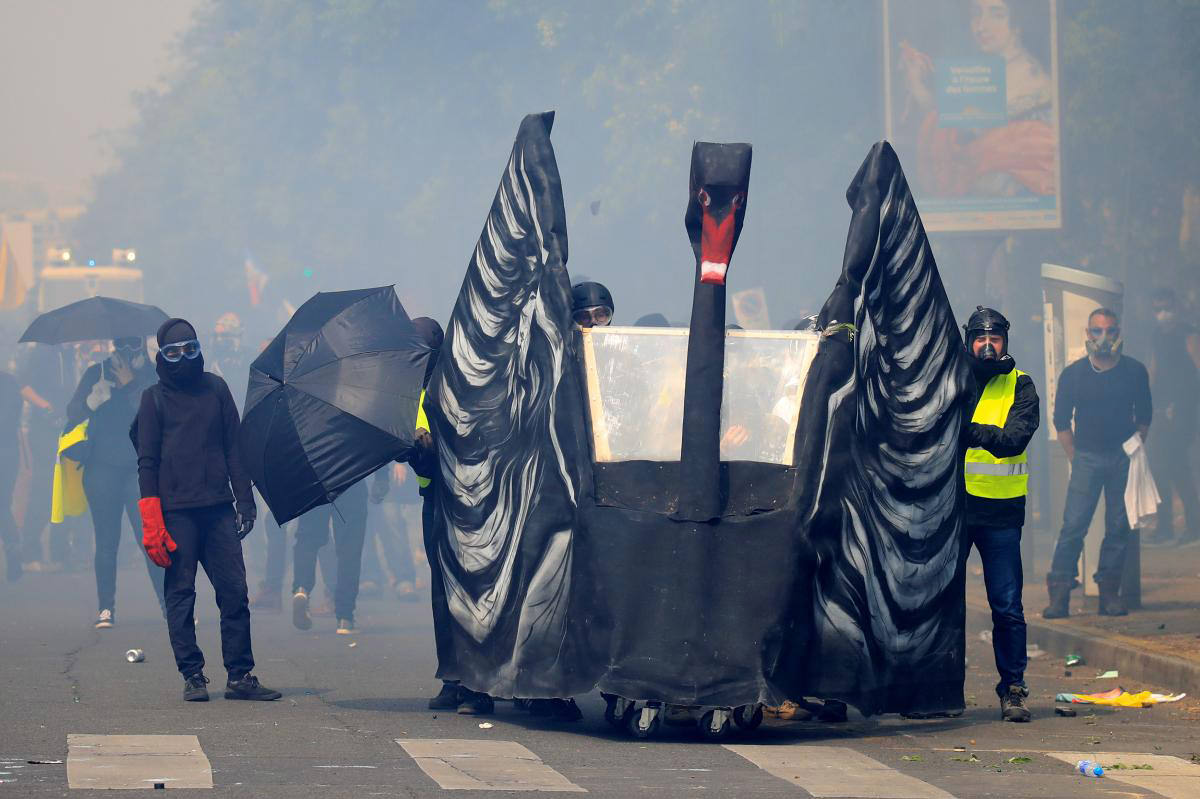
Demonstrators employ a parade float to protect demonstrators from police violence in Paris on May Day 2019.
Further Reading and Listening
- Haymarket and the History of Mayday: An Ex-Worker Podcast Episode
- May Day 2006: A Day without an Immigrant
- May Day 2006 poster
- May Day 2012 in the Bay Area
- May Day 2012 in Berlin
- May Day 2017 in Portland: Complete with a How-To Guide for Producing Giant Parade Floats
- May Day 2017 in Paris
- The Hotwire May Day 2018 Special
- May Day 2018 in Paris
- May Day 2019 in Paris
- May Day 2020 Call to Action: Resistance amid the COVID-19 Pandemic
- May Day 2020: Reports from around the World
- May Day 2025